

The Decision Before the Decision
... and what to do about it.

Welcome to KP on IE. I’m Kristina ‘KP’ Powers. I’ve spent 25+ years inside institutional effectiveness at colleges and universities. Each week, I write about what actually drives institutional performance, for the leaders responsible for it. For more: Powers Index™ | Powers Index OpenAI Plugin | EdUp Institutional Effectiveness podcast | Books | Institute for Effectiveness in Higher Education®

Most cabinet meetings have surprisingly few surprises. Everyone already knows who will advocate for the recommendation before it's presented, who will play captain obvious and name the risk everyone else is avoiding, and who will abstain, sit back, and let the outcome happen without adding their name to it. That predictability is the tell: the actual decision already got made before the meeting started, in whatever conversation decided which numbers would matter, which options would count as serious, and who would be treated as a stakeholder instead of an obstacle.
Presidents and vice presidents can see this choreography clearly enough to predict it in advance. What most cabinets never do is stop and ask why the outcome was so predictable in the first place. If leaders want better decisions, they have to get better at examining the decision before the decision, the one that happened before anyone opened the deck. With the launch of Priority Partners: Turning Vendor Spending into Mission Strength, vendor partnerships make a useful case study, because they show how often institutions treat what is actually a strategic choice about capacity, accountability, and mission delivery as though it were nothing more than an administrative detail. (It was just released a few days ago, I shared the news here, and it's available on Amazon now.)

Agreement Isn’t Decision Quality
In my recent conversations with leaders, the topic of decision-making is coming up over and over again. I’m seeing leaders misreading agreement as decision quality. A room can agree because the recommendation is strong, or it can agree because the alternatives were weak, the risks were softened, the dissenters weren’t present, or everyone was too tired to reopen the issue.
In January, I wrote about the quiet conversations surfacing across board discussions, accreditation work, financial planning, and vendor decisions before they get loud enough for anyone to name. This is one of them. Board members already know the difference between data being presented and data being used; most institutional decision processes just aren’t built to act on that instinct.
This isn’t unique to higher ed. Ohio State researcher Paul Nutt studied 350 corporate decision-making processes and found more than half failed to achieve their intended results, largely because leaders moved to solutions before they’d examined the problem from more than one angle, a pattern Harvard Business Review has been documenting for years. McKinsey’s Bias Busters series makes the same point with a harder example: the night before the Challenger launch, engineers had warned that cold temperatures could compromise the O-ring seals. NASA asked contractors to prove it was unsafe to launch, rather than asking whether anyone had evidence the seals would hold in freezing temperatures. The framing of the question determined the answer, and the answer was wrong.
The Question Behind the Question
With vendor and partnership decisions specifically, the question on the table is usually “should we renew this contract?” That may not be the real decision. The real decision may be whether the institution is comfortable depending on this partner for a mission-critical function, whether it has the internal capacity to manage the relationship well, and whether it’s buying performance, convenience, risk transfer, or temporary relief.
The quality of a decision is often determined before the recommendation is made, because whoever frames the problem quietly shapes the range of acceptable answers.
Five Questions Before the Vote
The fix isn’t more committees. It’s five questions, asked before the decision:
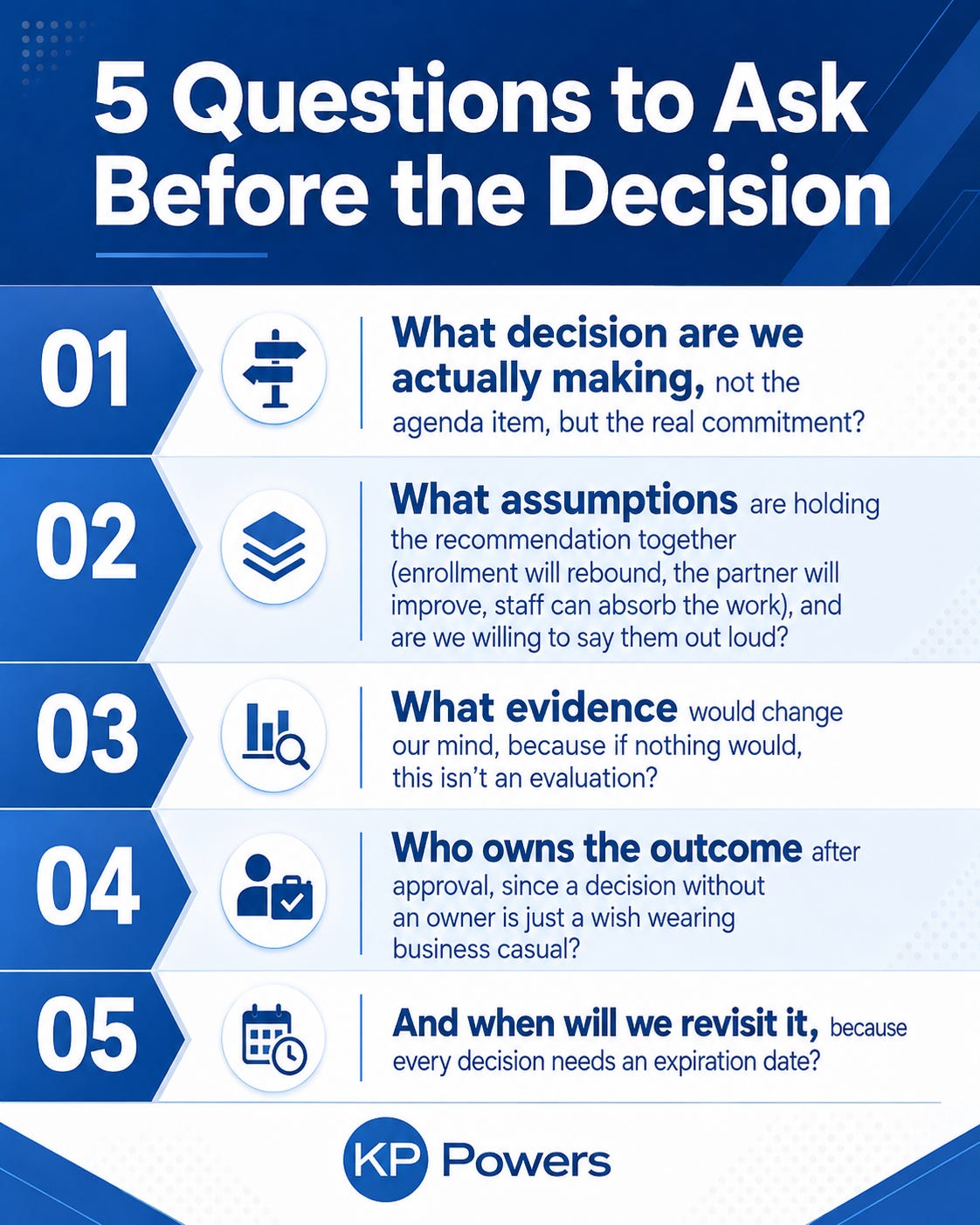
What decision are we actually making, not the agenda item, but the real commitment?
What assumptions are holding the recommendation together (enrollment will rebound, the partner will improve, staff can absorb the work), and are we willing to say them out loud?
What evidence would change our mind, because if nothing would, this isn’t an evaluation?
Who owns the outcome after approval, since a decision without an owner is just a wish wearing business casual?
And when will we revisit it, because every decision needs an expiration date?
I made a similar point in an earlier article: what actually happens in the room when leaders call something “data-driven decision-making”: the phrase describes an aspiration, not a process, unless someone is answering these questions on the record.
The Vendor Test
A vendor contract looks like a purchasing decision. It usually clarifies something larger: whether the institution is building internal capability or substituting for it, whether it’s strengthening mission delivery or managing around institutional weakness, and whether anyone would notice if the partner started underperforming. This is Signal 10: Partners territory, and it rarely shows up alone. The institutions that handle it well are also strong on Signal 4: Executive Leadership: someone with the authority to make the decision stick instead of letting it get revisited five times before anyone owns it.
AJ Prager, Managing Director at Prager Partners, has spent his career on the highest-stakes version of this question: institutional mergers and partnerships. In our recent conversation that we had on my podcast, EdUp Institutional Effectiveness, he shares that his firm doesn’t start by shopping an institution to buyers. It starts by defining mission with the leadership team first, then identifying which attributes (programmatic, geographic, demographic, financial) would actually amplify that mission, and only then building a ranked list of potential partners against those attributes.

That order is important: mission first, then partners. If you skip the mission step, you get a top-down decision that's called "strategic" when we all know it's not. Focus on the mission first, and the resulting partnership list has already survived initial scrutiny. The same discipline scales down to a five-figure vendor contract. If nobody has named what capacity the institution is actually trying to buy, the renewal conversation is a waste of time.
The Governance Behind the Deal
That discipline exists for a reason the federal government has already had to legislate. GAO reviewed how the Department of Homeland Security manages contractors performing functions closely tied to agency decision-making and found in 2020 that the government risks losing control of its own decisions and operations when those contracts aren’t governed with the oversight the function requires. Higher ed doesn’t have a GAO auditing its vendor relationships. It has whoever wrote the RFP three years ago, and whatever assumptions they never got around to revisiting.
Listen to the full conversation with AJ on Spotify or Apple Podcasts; he covers how the reception to institutional partnerships has shifted since 2016, why confidentiality shapes the entire process differently than in corporate M&A, and why he views partnership as a spectrum rather than a binary merger-or-nothing choice.
What Delay Actually Costs
When leaders delay the harder framing work, they don’t avoid a decision. They let inherited assumptions keep deciding. The institution renews because it renewed last year. It keeps a partner because switching feels disruptive. It avoids measuring performance because measurement would require a confrontation nobody wants to have. Delay doesn’t preserve optionality. It transfers authority to inertia.
The same dynamic is playing out one level up, in accreditation. IEHE Fellow Lori Williams, PhD, made this case on LinkedIn this week, and her full piece, Ready Before the Rules, lays out why: the institutions that will handle AIM (Accreditation, Innovation, and Modernization) well aren’t the ones with the best narratives, they’re the ones with the discipline to act on public evidence now, before a final regulation makes the decision on their timeline instead of their own.
The Powers Index™ in Practice
Which brings me to a question I put into the Powers Index™ OpenAI Plugin, the approved app inside the OpenAI ecosystem, which I wrote about in The Journey to OpenAI Plugin Approval. Free to use, no subscription required. I’ve included the verbatim response from OpenAI below.
The question to the Powers Index™ OpenAI Plugin,: “Give me tactical advice on how to encourage others to make better decisions in meetings. I'm a cabinet member.”
Note: Intelligence mode in ChatGPT was set to ‘medium’ for the response below.
If you’d rather run your own question, about your institution, your specific conditions, your situation, you can access the Powers Index™ OpenAI Plugin directly.

Response from the Powers Index in the OpenAI Plugin:
The relevant Powers Index lens here is mostly Executive Leadership, Monitoring, Transparency, Board Effectiveness, and Stewardship. In plain English: better meetings come from better decision architecture, not better exhortation.
The move is not to tell people they need to make better decisions. That will annoy them and change nothing.
Your move, as a cabinet member, is to quietly improve the decision architecture of the room.
The Powers Index read on this is mainly: Executive Leadership, Monitoring, Transparency, Board Effectiveness, and Stewardship. In practice, that means the leadership team needs clearer decision rights, better evidence discipline, fewer vague conversations, and more explicit follow-through.
Here’s the tactical playbook.
1. Separate discussion from decision
A lot of cabinet meetings underperform because no one knows whether the group is there to explore, advise, decide, bless, or defer.
Start using this language:
“Before we get into the substance, can we clarify what this item is? Are we discussing, recommending, deciding, or preparing something for the board?”
That one question immediately improves the meeting because it forces the room to locate itself.
You can also ask for agenda items to be labeled:
For awareness
For input
For decision
For board preparation
For follow-up/accountability
This sounds simple. It is not. It changes the room.