

The IR/IE Blur Zone
... and how to get focused.

Welcome to KP on IE. I’m Kristina ‘KP’ Powers. I’ve spent 25+ years inside institutional effectiveness at colleges and universities. Each week, I write about what actually drives institutional performance, for the leaders responsible for it. For more: Powers Index™ | Powers Index OpenAI Plugin | EdUp Institutional Effectiveness podcast | Books | Institute for Effectiveness in Higher Education®

The most common way an institution tries to strengthen its institutional effectiveness is to invest in more institutional research, and it has never produced the desired results on its own. Another dashboard, another analyst line, a better data platform: each addition improves what the institution knows, and none of them, by itself, changes what the institution decides and whether or not the institution improves.
The good news … The missing piece is not something you have to buy.
Different by Design, Stronger Together
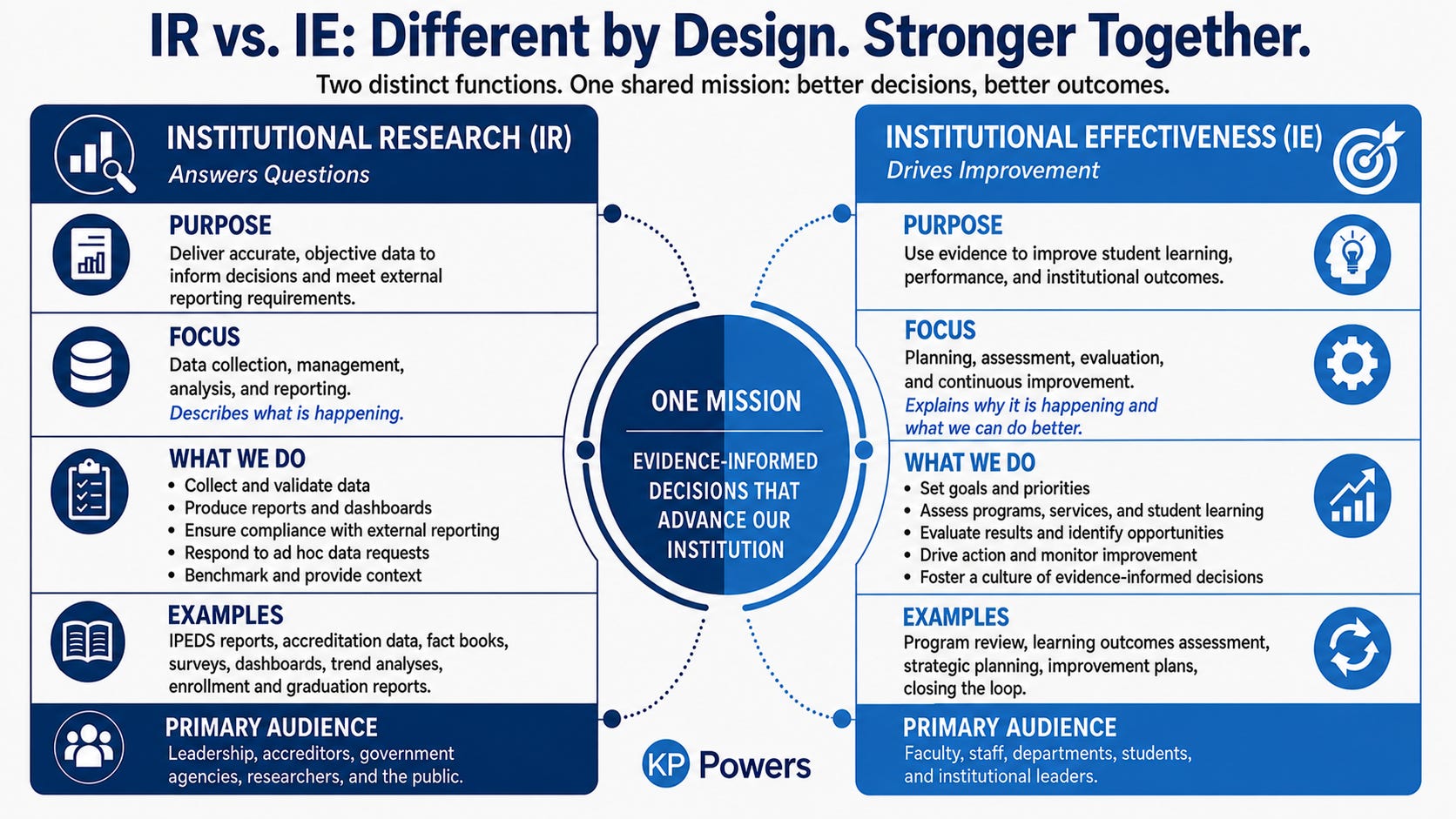
Both functions — IR and IE — are essential in their own right.
Institutional research establishes what is happening, with a rigor no institution can lead without.
Institutional effectiveness carries that finding through to a decision and back around to whether the decision worked.
Neither one substitutes for the other, and they produce the most when both IR and IE exist and work together (see image below). I made the full case for the distinction in What’s the Difference Between IE and IR?.
Plenty of institutions house both functions in a single office, and at smaller institutions, that often makes the most sense. Every so often, you find one person who is fluent in both languages, able to build the report and also carry it into the decision. Having spent my career learning to speak both, I can tell you that fluency is rarer than it should be. If that describes someone on your campus, you are one of the lucky ones, and the smartest thing you can do is everything in your power to keep them.
Start With the Decision
The order of operations on most campuses is backwards. Data should not be driving anything. The work starts with: what are we actually trying to decide? And only then does institutional research bring its professional judgment about what evidence would add value (not noise) to the conversation.
Ask any IR professional and you will hear the same thing: do not hand us a list of tables to pull. Give us the question, and we will tell you what information is relevant, what it can and cannot support, and where the risks in it sit. That judgment is the expertise you are paying for, and it only shows up when the question about what decision we are trying to make comes first.
Where the Blur Zone Opens
The blur zone is what opens when no one owns that sequence from end to end. A question gets asked, evidence gets assembled, and then the thread drops, because the step that carries a finding into a decision and back around to whether it worked belongs to no one in particular. That unassigned space is what I have come to call the IR/IE blur zone. Institutional research is doing its part well, the reports are accurate and the submissions are on time; what the blur zone leaves open is who owns the decision the work was meant to serve. It is one of the few institutional gaps a leader can close without a line in the budget.
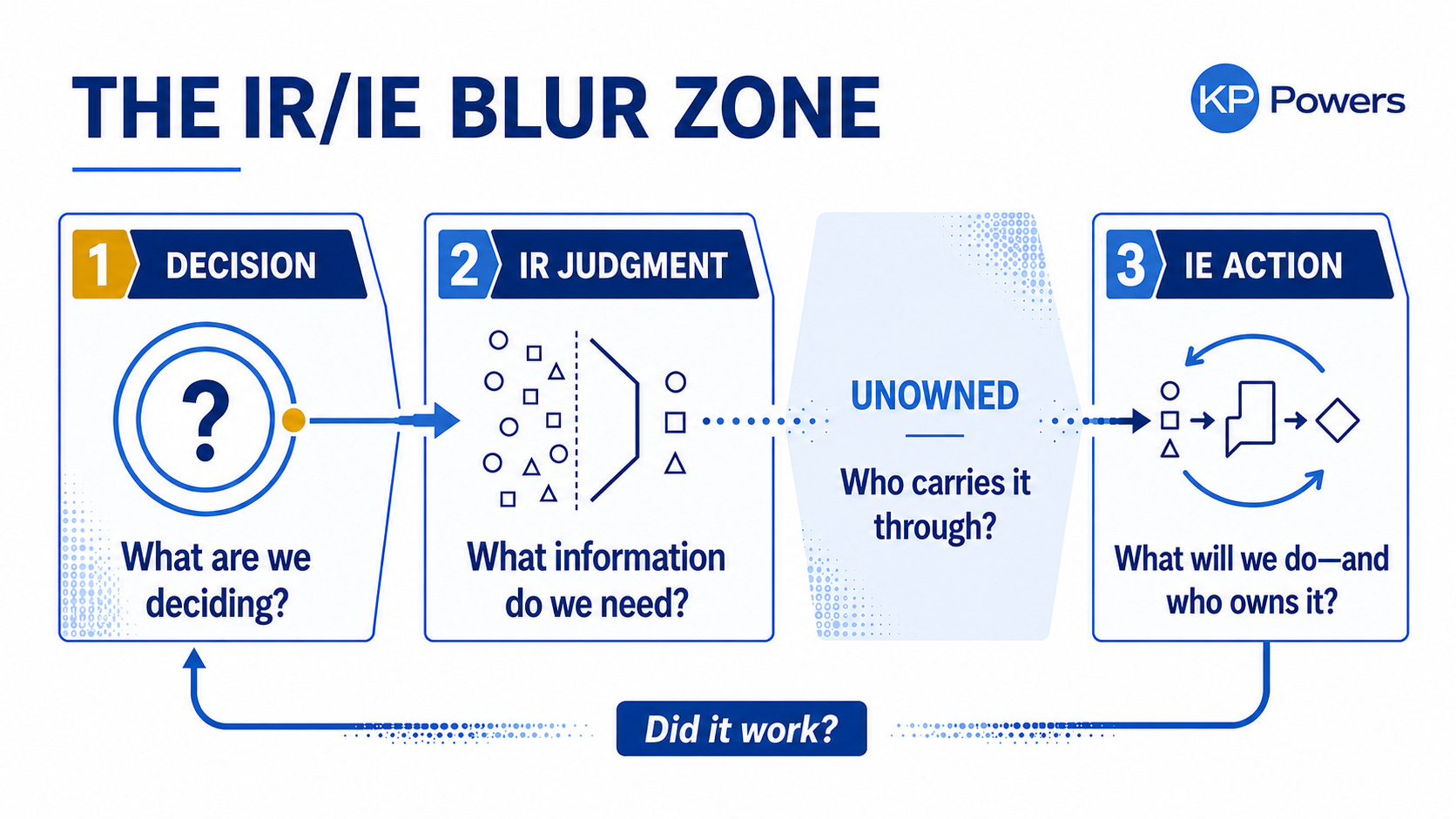
The blur zone sits with Executive Leadership first, because a leader decides who owns the move from evidence to decision whether or not the decision is ever named out loud. Most of the time it gets made by default. Institutions that move with purpose are simply the ones where a person is accountable for closing the loop.
The Expertise You’re Already Paying For
Assigning that owner also protects your Employee Expertise, which the blur zone otherwise draws down a little at a time. Your most capable data people (inside and outside of the IR office) spend a real share of the week re-explaining the same figures to the same audiences, because interpretation was never written into anyone’s role and so it lands on them by default. This is not a higher education peculiarity.
McKinsey’s analytics practice studied the same pattern across industries, named the missing piece the analytics translator, and found that many organizations realize as little as 10% of the value of their analytics investment for exactly this reason:
No one owns the ground between the people who produce the numbers and the leaders expected to act on them. In our higher education world, that translator is the institutional effectiveness function.
Wyntre Stout, PhD, sees this from a vantage point most of us never get, working alongside dozens of institutions at once. As Customer Insights and Success Manager at Precision Campus, and before that an institutional research manager, she watches the same pattern recur from one campus to the next, and her framing of the fix is the one I keep coming back to. The highest-value work an IR professional does is not running the recurring report for the hundredth time; it is helping a dean or a faculty member understand what the report means. Everything Wyntre builds is meant to take the routine reporting off the institutional research office so that their expertise can move to support the people making decisions.

Boards Can Already Tell
Wyntre was just as clear about what an unassigned loop does to trust. When no one owns the number, people show up with competing versions of it, each defends the one they built, and confidence gives way before a decision does. Boards notice this early. I argued in Boards Know the Difference that trustees can tell data being presented from data being used, and the tell is almost always whether one identifiable person owned the decision the data was meant to inform.
This is the quiet engine behind a paradox I described in More Data, Less Clarity: more dashboards, and steadily less confidence in what they mean. If data collection has an owner and interpretation doesn’t have one, then an institution accumulates evidence faster than it makes decisions. The remedy is a named owner for the decision.
The Fix: Name the Owner
The fix is specific and unglamorous. For a given question, name the person who owns the improvement loop, formalize it so that there is no ambiguity, give them the standing to convene the people who have to act, and set the cadence on which they bring the decision and its result back to leadership and the board. This does not require a new office. It requires named owners and leadership willing to hold them to it.
This is a good part of why I spent the last year on Priority Partners, available on Amazon now. A real partner company does more than deliver additional data. It absorbs the routine so the people serving inside colleges and universities are free to do the work only they can do, which is turning your institution’s evidence into your institution’s decisions.
You can hear the full conversation with Wyntre on Spotify or Apple Podcasts. She gets specific about how widely data maturity varies across institutions, the guardrails a partner company should insist on before AI goes anywhere near the numbers, and why the institutional knowledge an IR professional carries is the one thing automation cannot replicate.
The Powers Index™ in Practice
Which brings me to a question I put into the Powers Index™ OpenAI Plugin, the approved Plugin inside the OpenAI ecosystem, which I wrote about in The Journey to OpenAI Plugin Approval. Free to use, no subscription required. I’ve included the verbatim response from OpenAI below.
The question to the Powers Index™ OpenAI Plugin,: “What evidence would help us determine whether we need more analytical capacity—or better leadership ownership of the evidence we already produce”
Note: Intelligence mode in ChatGPT was set to ‘medium’ for the response below.
If you’d rather run your own question, about your institution, your specific conditions, your situation, you can access the Powers Index™ OpenAI Plugin directly.

Response from the Powers Index in the OpenAI Plugin:
The roles are clearly distinguished only if the institution can trace a consequential question through the entire improvement loop and identify a named owner at every stage.
A strong structure would look like this:
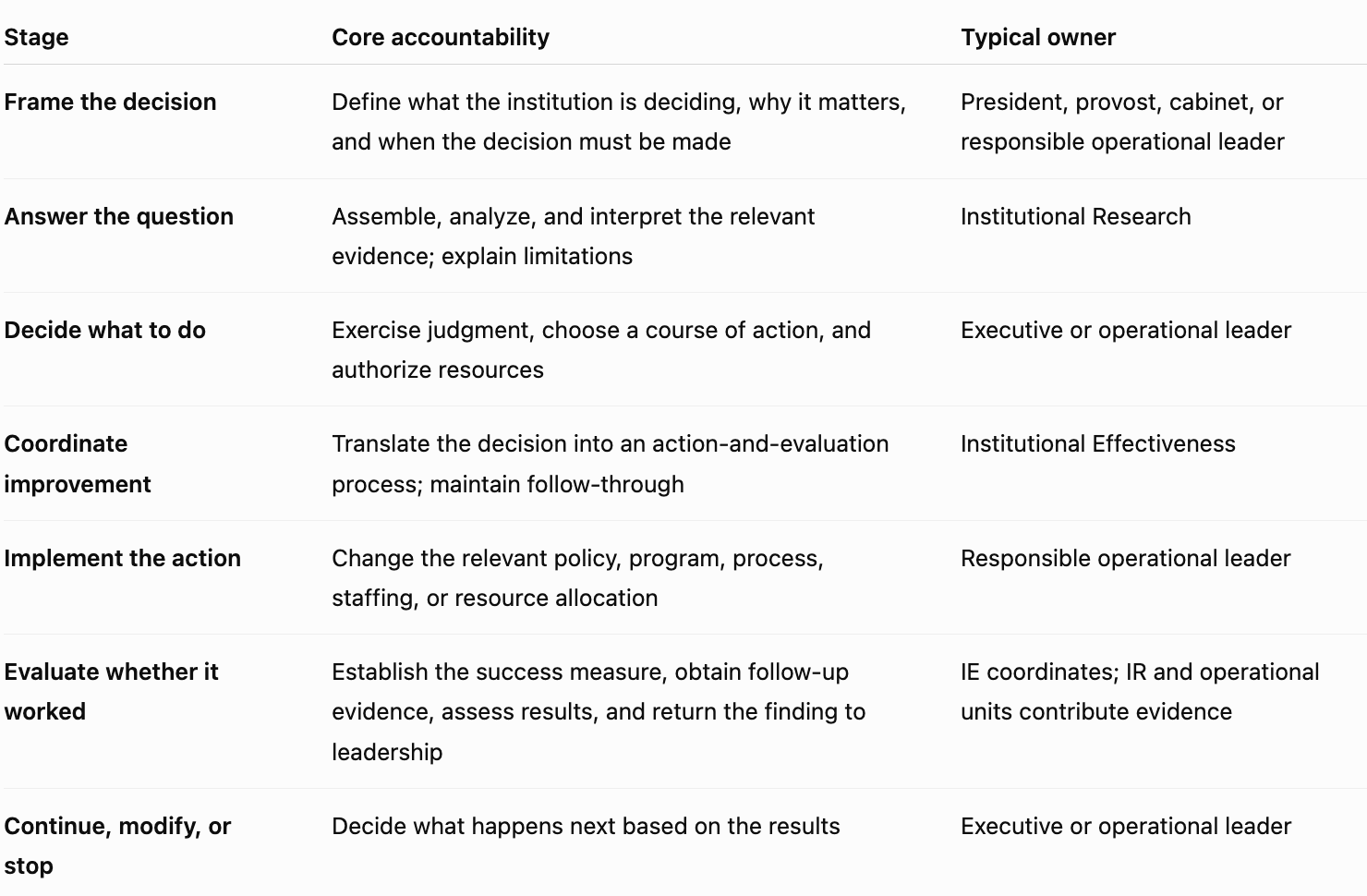
The critical distinction is that IR answers questions; IE drives improvement; leaders make and own decisions.
Neither IR nor IE should silently inherit leadership accountability. IR should not be expected to decide what the evidence means the institution must do. IE should not become the owner of every institutional action simply because it tracks improvement. The operational leader with the authority, budget, and responsibility for the affected area must own implementation.
What clarity looks like in practice
The institution likely has strong role clarity when: