

Transparency Creates Momentum
... it's not just about sharing more.

Welcome to KP on IE. I’m Kristina ‘KP’ Powers. I’ve spent 25+ years inside institutional effectiveness at colleges and universities. Each week, I write about what actually drives institutional performance, for the leaders responsible for it. For more: Powers Index™ | Powers Index OpenAI Plugin | EdUp Institutional Effectiveness podcast | Books | Institute for Effectiveness in Higher Education®
Transparency Creates Momentum
You’ve solved the same problem as someone two buildings over… multiple times. Neither of you knows it, because the work that was done never left the office where it happened.
That’s the real cost of invisible work. It rarely goes undone; it gets done twice, separately, by two people who each assume they’re the only ones stuck on it. I saw the opposite of that pattern last week at HigherEd PodCon II, where people who work on podcasts, across every role, not just the names on the mic, spent the conference doing something podcasts themselves never do: talking openly about the work nobody hears or sees, the editing, the scheduling, the judgment calls about what makes the final cut. Saying it out loud, in a room full of people who recognized it instantly, is what built the trust and connection that created fantastic energy throughout the conference.
The EdUp Framily, in Person
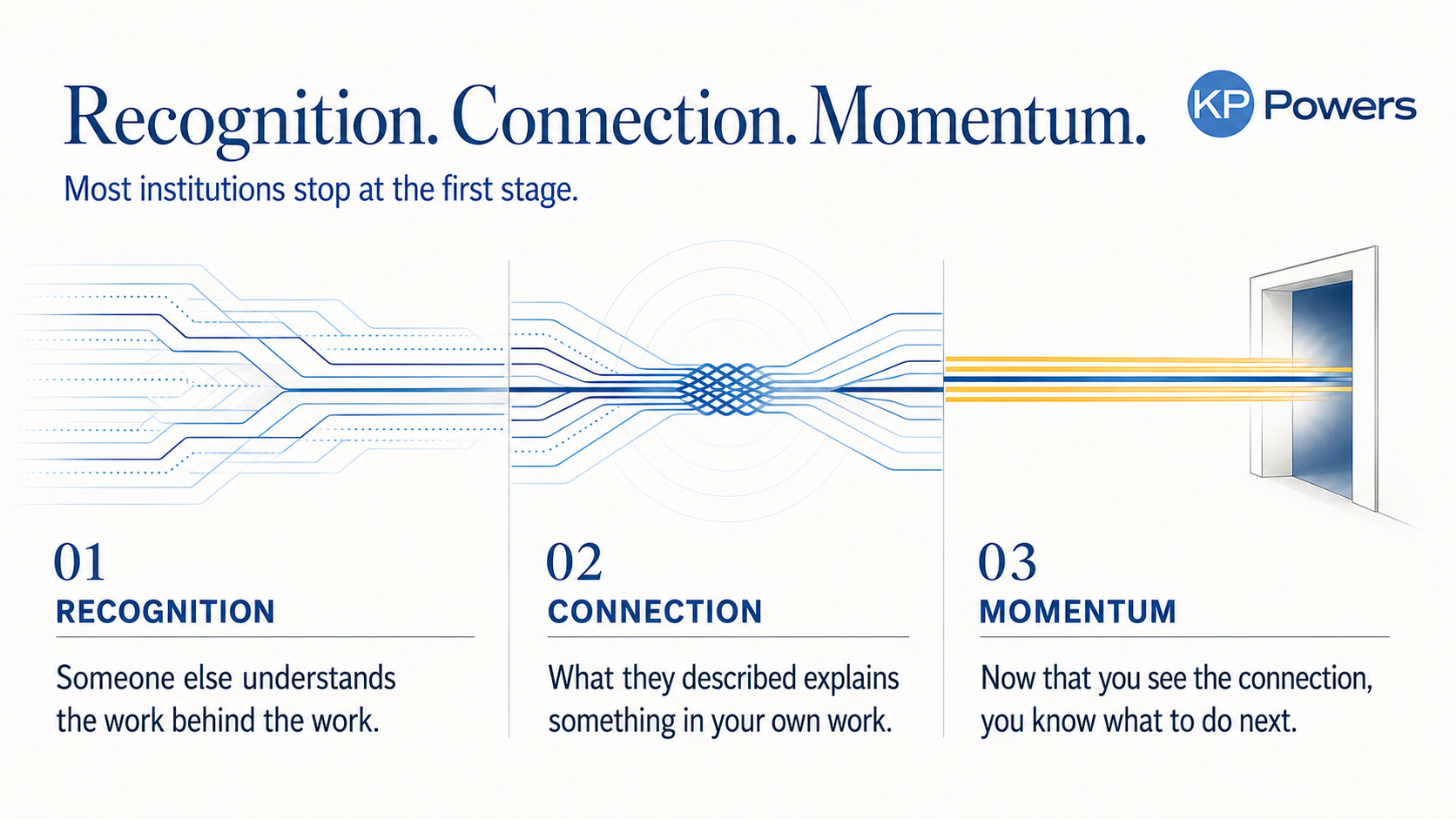
That trust is also what let me finally hug my EdUp framily (friends who have become family). I’ve known Joe Sallustio and Elvin Freytes — Co-Founders of The EdUp Experience and HigherEd PodCon — for nearly seven years. And last week at HigherEd PodCon II, I met them in real life for the first time … in seven years! I was their 12th guest on The EdUp Experience, back when their podcast was brand new, and the pandemic had just started. They’re past 1,500 episodes now.
Seven years of trust built entirely at a distance, then finally standing next to each other … I had to get a picture (below). Earlier this year, I became part of the EdUp Framily with the addition of my own podcast — EdUp Institutional Effectiveness. The group photo below includes all of the attendees who are part of the EdUp network.
As an added bonus, I also had the chance to see longtime colleague and friend John Ingram, whom I hadn’t seen in a few years. As a chapter author in Priority Partners, John will be a guest on an upcoming episode of EdUp Institutional Effectiveness. And to see HigherEd PodCon conference coordinator Dean Hoke (not pictured) — he was too busy running an energetic conference to catch him for a photo.
Recognition, Connection, Momentum
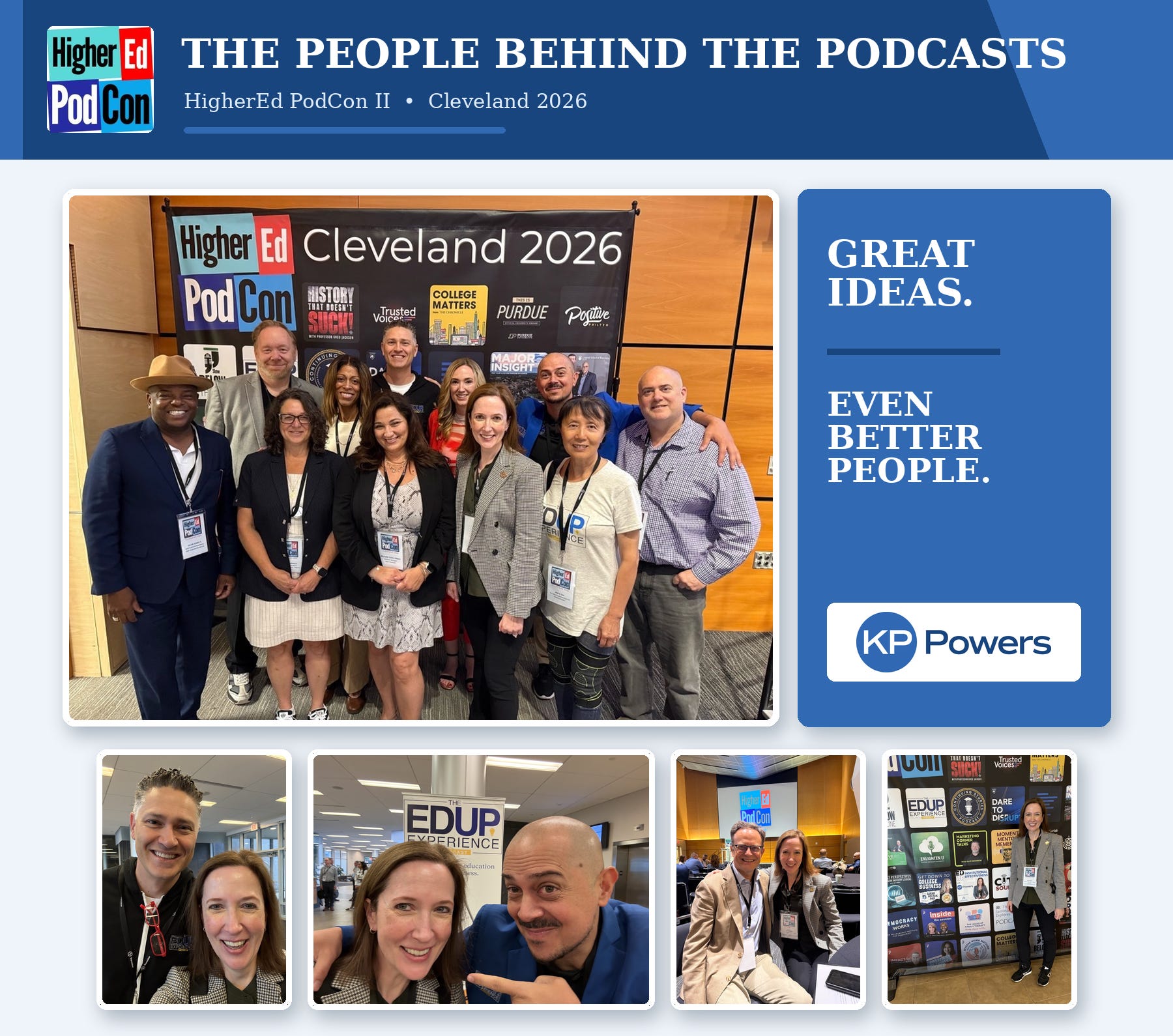
None of those reunions was an accident. They were years of working in the open finally converging in one room, where recognition became connection and connection became a reason to do something next. That same movement, from private work to shared action, happens in three stages, and each one loses people. Most institutions reach the first, fewer get to the second, and almost none act on the third, the only one that changes anything.
Recognition: someone else understands the work behind the work.
Connection: what they described explains something in your own work.
Momentum: now that you see the connection, you know what to do next.
That third stage is the one that matters. Momentum is where private insight becomes an institutional move, the same shift I wrote about in From Data to Intelligence: the value was never the data itself, it was the moment someone turned it into an intelligent decision they would actually act on. Transparency did more than build trust at HigherEd PodCon II. It lets one person’s experience become useful to someone else. People compared approaches, connected dots, and moved their own thinking forward. What had been private work became shared knowledge.
Transparency turns “I thought it was just me” into “we can do something with this.”
Where This Shows Up on Campus
Colleges and universities carry out the same private work, spread across separate offices that rarely compare notes. I’ve spent 25+ years in institutional effectiveness, engaged in cross-functional projects, and the pattern holds in both directions: people solve the same problems, hit the same walls, and build workarounds that never become transparent as they should be. An enrollment team spends March solving a yield problem that a retention team quietly rediscovers in April, not because the knowledge didn’t exist, but because nobody said it out loud in a room where the right person was listening. When the work becomes visible, people see where they overlap, stop assuming they’re the only ones stuck, and build on what’s already been figured out.
Why the Conference Felt Energetic
Two pieces of research explain why the HigherEd PodCon II conference felt so energetic… not just for me, but for everyone there. A study on live concerts and collective effervescence found that the emotional lift from a shared experience outlasts the event itself, measurable in people’s mood days later. A 2026 review of “swift trust”, how strangers in temporary groups end up trusting each other without any shared history, found that people extend trust based on what’s visible up front and adjust from there.
Transparency is one of the fastest signals available. It’s why a room of strangers at a conference can trust each other faster than two offices that have shared a hallway for a decade, and why seven years of showing up for each other from a distance can turn into an instant genuine hug the first time you’re finally in the same room.
The Gap Momentum Closes
Neither piece of research gets you to momentum. Recognition and connection can happen in a room and be gone a few days later. I wrote about a version of this gap in Every Institution Has a Data Culture: most institutions aren’t short on insight; they’re short on the structure that turns insight into a decision somebody actually acts on. The same gap shows up with momentum as it needs an owner; someone whose job it is to turn “I didn’t know you were stuck on that too” into an actual conversation with a next step attached.
Signal #2 (Transparency) opens the door. A working Signal #10 (Partners) relationship keeps it from swinging shut, the argument I made in Partnership as Operational Infrastructure. It’s also the whole premise of Priority Partners, available now: the connective tissue between a good relationship and a real result has to be built on purpose. It doesn’t show up on its own.
The Powers Index™ in Practice
Which brings me to a question I put into the Powers Index™ OpenAI Plugin, the approved Plugin inside the OpenAI ecosystem, which I wrote about in The Journey to OpenAI Plugin Approval. Free to use, no subscription required. I’ve included the verbatim response from OpenAI below.
The question to the Powers Index™ OpenAI Plugin,: “How do I create greater transparency on my campus to move from recognition to connection to momentum?”
Note: Intelligence mode in ChatGPT was set to ‘medium’ for the response below.
If you’d rather run your own question about your institution, your specific conditions, your situation, you can access the Powers Index™ OpenAI Plugin directly.

Response from the Powers Index in the OpenAI Plugin:
Greater transparency does not come from sharing more information. It comes from making the work understandable, helping people see how it connects to their own responsibilities, and closing the loop with action.
That distinction matters. A campus can publish dashboards, hold town halls, and send detailed updates while still leaving employees unable to answer three basic questions: Why is this happening? How does it affect our work? What happens next?
Use a repeated Recognition → Connection → Momentum cycle around real campus work:
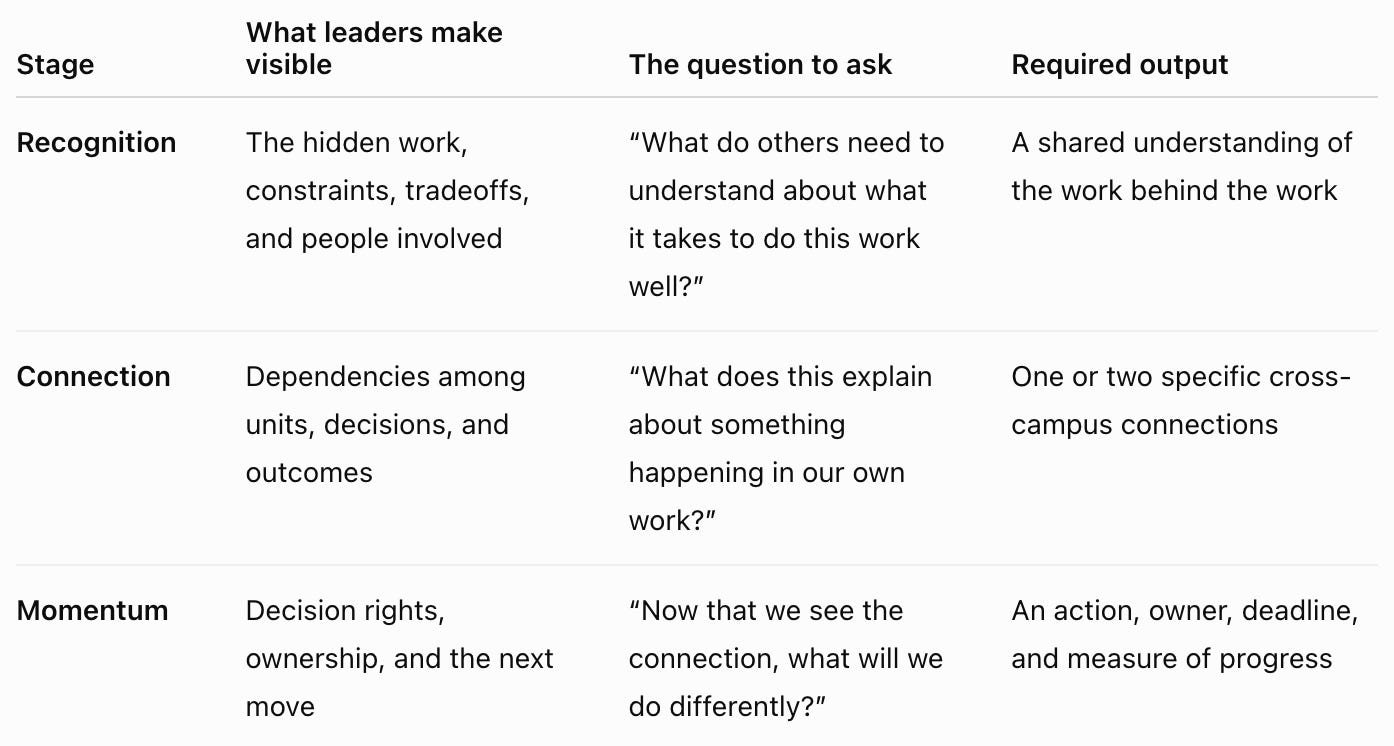
Recognition: Make the work legible
Recognition begins when people closest to the work can describe what is really happening—not only the finished report, final decision, or visible result.
Ask them to explain: